An Asynchronous Energy-Harvesting Pixel for CMOS Image Sensors
Abstract
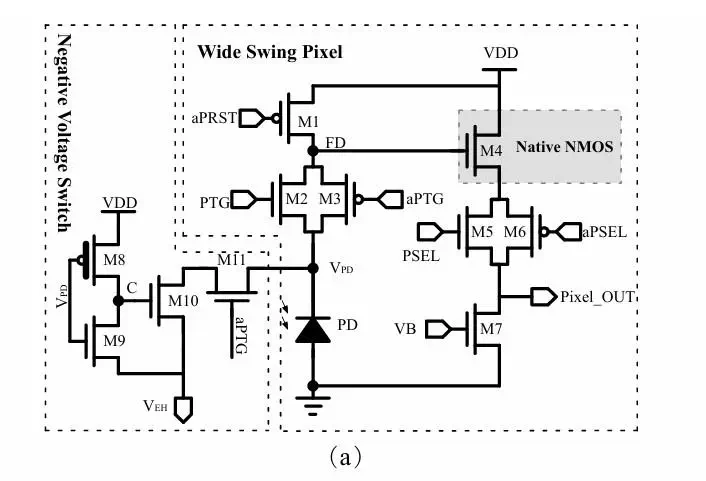
This letter presents an asynchronous energy-harvesting active pixel that provides a novel solution for self-powered image sensors. The proposed design employs a negative-voltage switch that automatically transitions the photodiode from imaging mode to energy-harvesting mode when the photodiode voltage drops below a threshold, without requiring synchronized timing control. By utilizing idle windows within the frame period, the pixel can achieve simultaneous imaging and energy harvesting within a single frame cycle. The prototype, fabricated in a standard 0.18-μm CMOS process, operates at a 1 V supply with a frame rate of 35.9 fps, consuming a total power of 3.98 μW. It achieves a dynamic range of 45 dB, a pixel fill factor of 55.76%, and an energy-harvesting efficiency of 60.1 pW/lux/mm² while maintaining full imaging functionality.

Zhipeng Li
PhD Student
My research interests include circuit design of image sensors and energy harvesting circuits.

Jingjing Liu
Associate Professor
My research interests include low-power smart micro-sensor integrated circuit design, image sensors, biomedical sensors, and energy harvesting circuits.



Bingjun Xiong
PhD Student
My research interests include circuit design of optical receivers and references.

Jian Guan
PhD Student
My research interests include the design of solar cells and energy harvesting circuits.

Feng Yan
PhD Student
My research interests include circuit design of analog front end for biomedical applications and sensor interfaces.

Kangkang Sun
PhD Student
My research interests include circuit design of analog to digital converter for biomedical applications and SAR ADC.