An Ultra-low Power CMOS Subthreshold Voltage Reference with Temperature Coefficient Compensation
Abstract
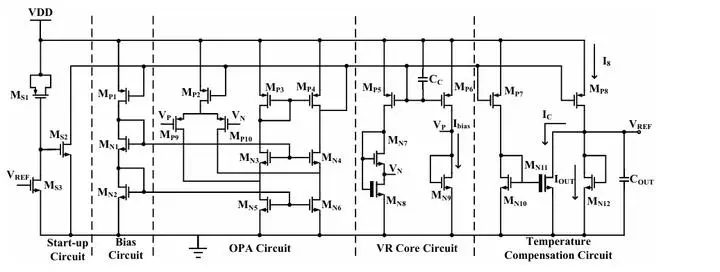
This paper presents a nanowatt voltage reference (VR) with an ultra-low power consumption temperature coefficient compensation. All transistors are biased in the subthreshold region to reduce the power consumption of the proposed VR circuit. The complementary-to-absolute-temperature (CTAT) voltage and proportional-to-absolute-temperature (PTAT) voltage are mainly generated by two NMOS transistors with different threshold voltages. At the same time, a simple temperature compensation circuit is designed to optimize the temperature coefficient at high temperatures, so that the circuit can generate a reference voltage with a wider temperature range and a lower temperature coefficient. The proposed VR circuit is fabricated in a 0.18-μm CMOS process with a silicon area of only 0.022 mm2. Theoretical analysis and post-layout simulation results verified the reliability and performance improvement of circuit operation. The proposed VR circuit generates a reference voltage of 308.21 mV with a temperature coefficient of 6.42 ppm/℃ over a wide temperature range of −40 ~ 40 ℃. The power consumption of the circuit is 7.04 nW. The voltage line sensitivity (LS) is 0.099%/V.




Zhipeng Li
PhD Student
My research interests include circuit design of image sensors and energy harvesting circuits.


Jingjing Liu
Associate Professor
My research interests include low-power smart micro-sensor integrated circuit design, image sensors, biomedical sensors, and energy harvesting circuits.