An Ultra-wideband Vivaldi Antenna with Stable Radiation and Balanced Feeding Techniques
Abstract
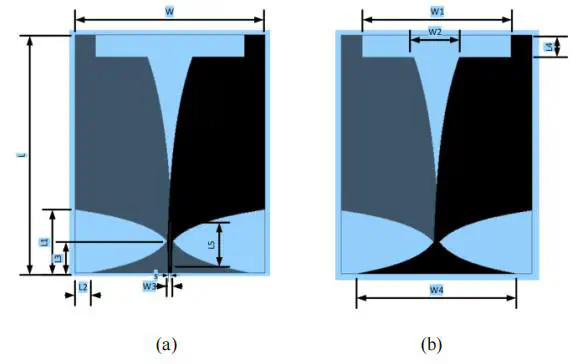
A miniaturized double-exponentially tapered Vivaldi antenna for 3–18 GHz ultra-wideband (UWB) applications is proposed in this paper, which is fed by an optimized microstrip-to-slot line transition. It achieves a 6:1 bandwidth ratio through three key innovations: (1) a compact broadband balun with a graded coplanar strip line (CPS) impedance transformer that makes VSWR less than 2 at frequencies below 3 GHz, (2) a balanced feed mechanism combining a half-wavelength extended current slot and quarter-wavelength dumbbell-shaped choke to equalize ground-to-radiator current distribution and prevent pattern distortion, (3) optimized integration of these techniques minimizing gain reduction while maintaining impedance matching. Based on a 0.813-mm thick RO4003C substrate, the integrated feed occupies only 0.21 × 0.17 λ0^2 at 3 GHz. Simulation results reveal a VSWR of less than 2 across the 3–18 GHz range, with a peak gain of 11 dBi at 18 GHz and gain fluctuations of under 3 dB. Additionally, the antenna exhibits stable radiation patterns, thereby advancing UWB antenna technology by effectively addressing impedance matching, miniaturization, and radiation stability.


Weijie Ge
PhD Student
My research interests include the design of radio frequency integrated circuits and energy harvesting circuits.

Jingjing Liu
Associate Professor
My research interests include low-power smart micro-sensor integrated circuit design, image sensors, biomedical sensors, and energy harvesting circuits.