A 185 dB FoMS Direct-Integration Third-Order Passive Noise-Shaping SAR ADC for Biomedical Applications
Abstract
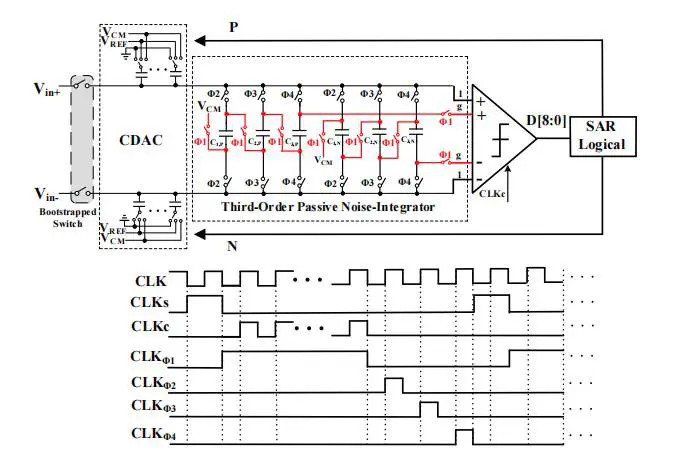
This paper proposes a high-energy-efficiency, direct-integration third-order passive noise-shaping (NS) successive approximation register analog-to-digital converter (SAR ADC) for biomedical applications. By directly sampling the residue voltage on the integrator and connecting the integration capacitors to the comparator through a charge-pump cascade, the proposed NS SAR ADC significantly reduces quantization-noise loss during the sampling/integration process, relaxes the gain requirement of the differential input pairs, lowers comparator power consumption, and enhances noise-shaping performance. The proposed NS SAR ADC is designed based on a standard 180nm CMOS technology. Under a 1.2V power supply, the ADC achieves 87.36 dB signal-to-noise-and-distortion ratio (SNDR) over a 55.6 kHz bandwidth at 1.78 MS/s while consuming only 9.67 μW. The corresponding Schreier figure-of-merit (FoM) is 184.96 dB and the Walden FoM is 4.6 fJ/conversion-step, offering an energy-efficient solution for ultra-low-power biomedical systems.

Kangkang Sun
PhD Student
My research interests include circuit design of analog to digital converter for biomedical applications and SAR ADC.
Weijie Ge
PhD Student
My research interests include the design of radio frequency integrated circuits and energy harvesting circuits.

Feng Yan
PhD Student
My research interests include circuit design of analog front end for biomedical applications and sensor interfaces.

Bingjun Xiong
PhD Student
My research interests include circuit design of optical receivers and references.

Jian Guan
PhD Student
My research interests include the design of solar cells and energy harvesting circuits.

Jingjing Liu
Associate Professor
My research interests include low-power smart micro-sensor integrated circuit design, image sensors, biomedical sensors, and energy harvesting circuits.